StudyDuo
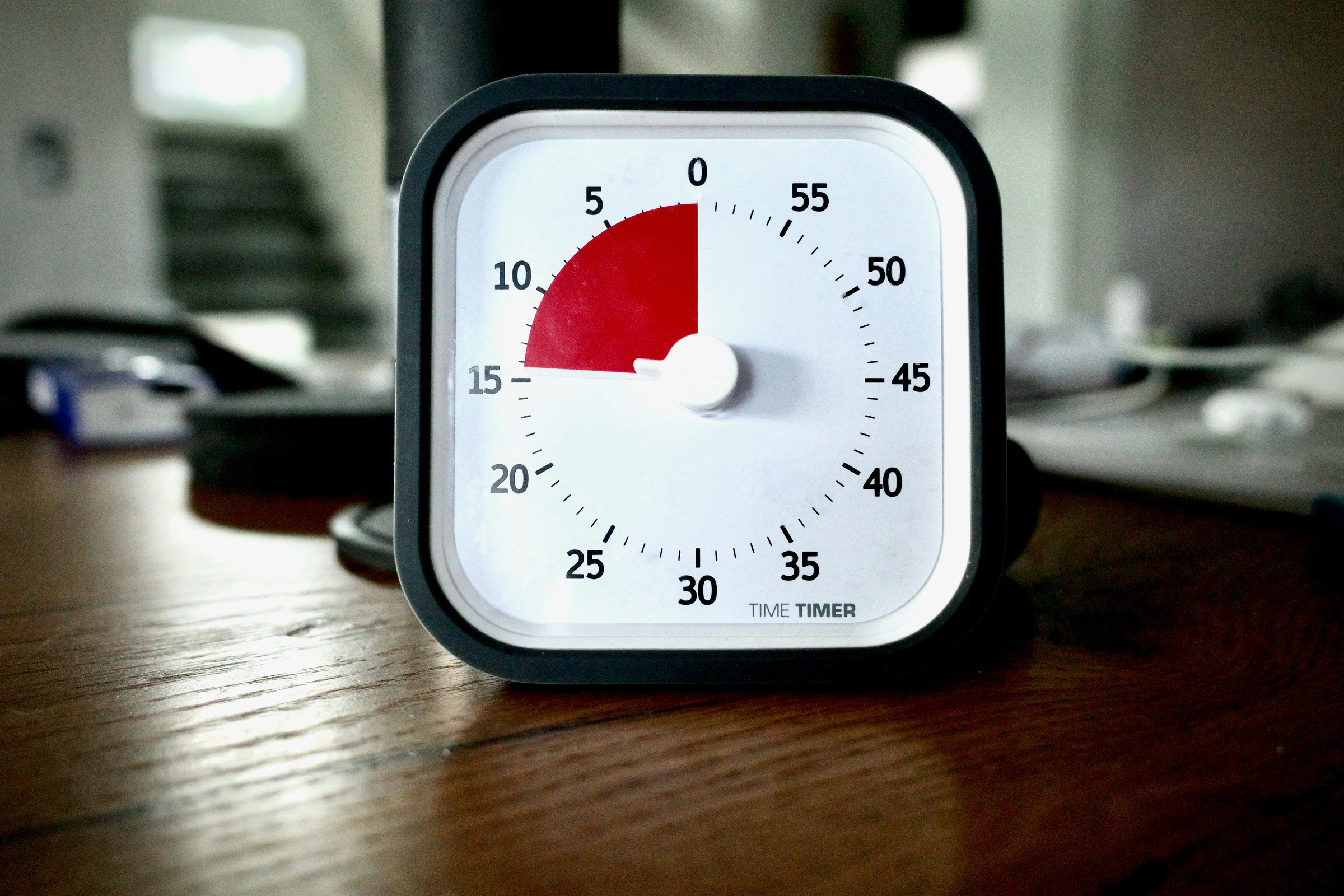
Does Pomodoro work for ADHD? For some people, yes, though rarely in its classic 25/5 form, and no published trial has tested it in students or adults with ADHD. In three experiments with students, fixed Pomodoro-style breaks never beat self-chosen breaks on work done or test scores. The timer's outside structure is the useful part, so change the numbers to fit you.
What the Pomodoro Technique asks of you
Francesco Cirillo began developing the technique in the 1980s while preparing for a university exam. His own site says his first challenge was to concentrate for just two minutes, using a tomato-shaped kitchen timer. Pomodoro is Italian for tomato.
The version most people know is stricter. You work for 25 minutes and rest for 5, and after four rounds you take a longer break of 15 to 30 minutes, as a 2025 study sums it up. Cirillo's site also tells you to try small adjustments and build a rhythm that works for your circumstances. Changing the numbers is part of the method, not a failure at it.
The clock is only part of the method. Cirillo's site also asks you to handle internal and external interruptions and to record interruptions and the effort tasks really took. Jotting down the urge to check something and carrying on is part of the original technique, not an extra.
Does Pomodoro work for ADHD? What the research says
Search PubMed for "pomodoro" and you get 22 records as of November 2026. Only four are about studying: three experiments from Maastricht University in the Netherlands and one review. None of them looked at ADHD, so what follows comes from students in general.
| Study | Who | Breaks compared | What they found |
|---|---|---|---|
| Biwer et al., 2023 | 87 students, a day of their own studying | 24 minutes on and 6 off, 12 on and 3 off, or their own choice | Both fixed schedules got the same work done in less time |
| Smits, Wenzel and de Bruin, 2025 | 94 students, two hours of their own tasks | 25/5, Flowtime, or their own choice | No difference in tasks finished, productivity or flow; motivation fell faster on 25/5 |
| Göksu, Wiradhany and de Bruin, 2026 | 176 students, one hard text, then a test | 12 on and 3 off, or their own choice | Same test scores; more energy, concentration and motivation with their own breaks |
So the schedule changed how the session felt, in both directions, but not how much students got done or learned. That makes Pomodoro a matter of fit rather than a proven boost.
One popular figure needs a warning label. Some Pomodoro pages cite exam scores of 82% against 70%, credited to a 2025 scoping review of 32 studies. In the review, those numbers sit in a table that names no study behind them. Its author rated the overall certainty of the evidence "moderate to low", and the word ADHD doesn't appear in it.
Why 25/5 trips up many ADHD brains
With no ADHD trial to go on, the next best guide is what's known about ADHD and attention. Four parts of the classic schedule run into it.
The bell rings during hyperfocus
Many adults with ADHD describe long stretches of intense focus, often called hyperfocus. In a 2019 study by Kathleen Hupfeld, Tessa Abagis and Priti Shah, adults with more ADHD symptoms reported more hyperfocus at school, in hobbies and on screens. The pattern showed up in a first sample of 251 adults and again in a second of 372. A bell that stops you mid-flow throws away a state that may have taken a while to reach.
25 minutes is the wrong size
Time is harder to judge with ADHD. A 2024 meta-analysis pooled 824 effect sizes from studies of time perception. People with ADHD did worse than people without it, a medium-to-large gap (g = 0.69) that varied with age. If it takes you 15 minutes to warm up, a 25-minute block leaves about 10 good ones before the bell.
Every break means starting again
For many people with ADHD, starting is the hardest part of any task, and the classic cycle asks you to start four times before the long break. In the 2026 Maastricht study, most students found its schedule of 12 minutes on and 3 off "too frequent and too short", and the authors suggest testing longer blocks next. More on that first step: how to start studying with ADHD.
The break turns into scrolling
In the same 2026 study, the most common break activity was checking social media or messages: 49.6% of what students reported doing, ahead of getting a drink at 22%. On a phone, a five-minute break has no natural end.
How students felt also depended on who decided when to stop. These were averages over the session, on a scale from 1 to 5:
| Mood | Fixed 12/3 breaks | Breaks they chose |
|---|---|---|
| Energy | ||
| Concentration | ||
| Motivation | ||
| Distraction |
Most students who chose their own breaks took just one in the hour. The authors still note that fixed breaks may suit students who prefer outside guidance or have trouble deciding when to take a break. If that's you, the timer may be worth keeping.
6 Pomodoro alternatives for ADHD
If the answer to "does Pomodoro work for ADHD" is "not for me", keep the outside structure and change the shape. These six Pomodoro alternatives for ADHD each fix a different part of the problem:
| Method | How it works | Why it may suit ADHD | Watch out for |
|---|---|---|---|
| Short sprints | 10 to 15 minutes on, a few minutes off | Easy to start; Cirillo's own first goal was two minutes | More restarts per hour |
| Long blocks | 45 to 60 minutes on, 10 to 15 off | Time to warm up and stay in flow | Harder to begin on a bad day |
| Flowtime | Work until focus fades; the break grows with the block | No bell during hyperfocus | You have to notice when focus fades |
| Your own breaks, with a cap | Stop when you choose, but decide the break's length before it starts | Students rated self-chosen breaks higher in the 2026 study | Breaks stretch without the cap |
| A fixed hour with others | Everyone starts at the same moment and works an hour with no breaks | Someone else's start time gets you going | The hour may not fit your day |
| A visible timer | A clock that shows time running out, sound off | Makes time you can't feel visible | Watching the clock instead of working |
Flowtime has no fixed rule. The 2025 study used this one: a 5-minute break after up to 25 minutes of work, 8 minutes after 25 to 50, and 10 minutes after more than 50.
A fixed hour with others is the idea behind StudyDuo's Study Hour. Once a day, everyone studies together at the same time, shown in your own time zone. The room opens 10 minutes early, then it's one hour of focus with no breaks and a check-in in the app: did you get it done? Focus Room, for any other hour, is open 24/7 with mics off. Working next to people like this is called body doubling online; the research on it is thin and mixed, as this guide explains.
Tune it to your brain in a week
- Time your warm-up. For two sessions, note how many minutes pass before real work starts. Make your block at least that long plus 10 minutes.
- Treat the bell as a question. If it rings mid-flow, finish the paragraph or problem first. That's Flowtime in practice.
- Write the restart before you stop. One line on a sticky note with the very next action, such as "finish question 4", turns restarting into reading.
- Keep the break off your phone. Stand up, get water, look out the window. Leave the phone in another room for the whole session.
- Time the break, not just the work. Set a timer for the break too. In the 2026 study, the breaks were where social media came in.
- Count what you finished. At the end of the week, compare tasks done, not minutes logged, for each schedule you tried.
If you end the week thinking "Pomodoro doesn't work for me", keep the parts that did: a start time, a visible clock, a person nearby. A week of notes like this answers "does Pomodoro work for ADHD?" more reliably for you than any study so far.
When it isn't the timer
A schedule can make work easier to start, but it isn't treatment for ADHD. If nothing helps you focus, wherever you work, or you're also sleeping badly or feeling low for weeks, see a doctor.
For choosing a session length beyond the 25-minute default, see how long a study session should be.
FAQ
Where does the 52/17 rule come from?
From DeskTime, a time-tracking company. In 2014 it analyzed one workday of computer use by the most productive tenth of people its software tracked, and found they worked 52 minutes and rested 17. It wasn't a peer-reviewed study, and the company's own rerun in 2021 found 112 minutes of work and 26 of rest.
Can I use Pomodoro with a body double?
Yes. Many online study rooms and Discord servers run a shared timer, so everyone breaks at the same moment. If the shared breaks pull you out of focus, pick a room without one and keep your own rhythm.
Is a timer app or a kitchen timer better?
A separate timer keeps your phone out of reach, which matters because social media and messages were the most common break activity in the 2026 study. If you use an app, start it and put the phone face down across the room.
Does Pomodoro help with time blindness?
It gives time an outside marker, which is the point for people who can't feel time passing. A visual countdown that shows the remaining time shrinking does this better than a beep at the end.