StudyDuo
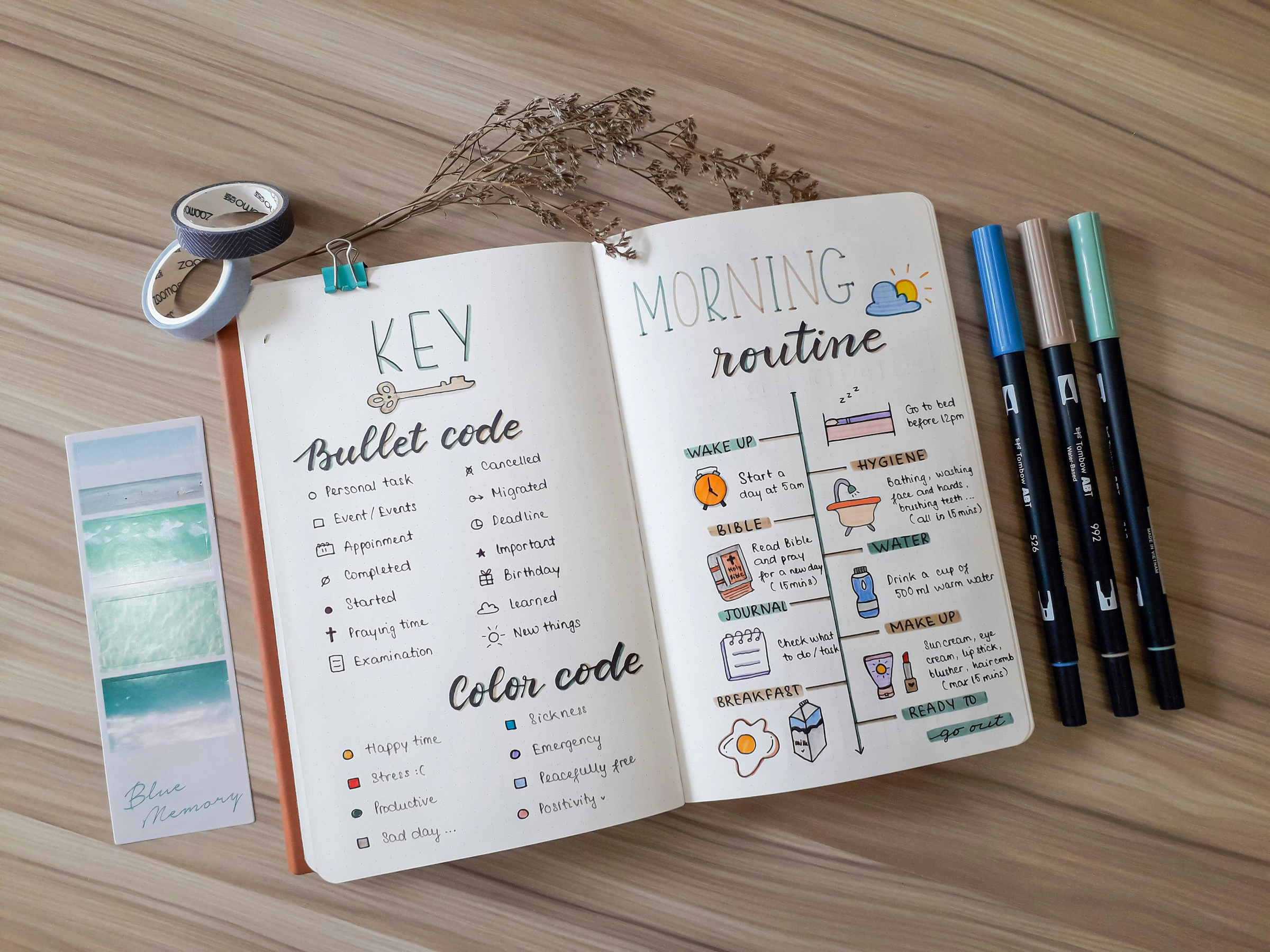
The answer to how to hold yourself accountable for studying is a ladder: each rung makes a skipped session cost a little more. Start with a written goal and a plan for the obstacle, and keep your own record. Then add costs other people can see: a public promise, money at stake, and a room where others watch you work.
Below are its seven rungs, weakest first. "Weakest" here means easiest to skip without anyone knowing, not least effective. No study has compared all seven head to head, so each comes with its own evidence and its limits.
The seven ways at a glance
| Way | Who knows if you skip | What skipping costs | Evidence |
|---|---|---|---|
| 1. A decision | Only you | Nothing | A meta-analysis of 47 experiments |
| 2. A written goal | Only you | A broken promise on paper | A program for 703 first-year students |
| 3. An obstacle plan | Only you | A plan you wrote for this exact moment | A meta-analysis of 21 studies |
| 4. Your own record | Only you, in numbers | A gap you can't argue with | An experiment in a graduate statistics course |
| 5. A public promise | The people you told | Face | A meta-analysis of commitment studies |
| 6. Money at stake | You and whoever holds the stake | Money | A year-long field experiment at work |
| 7. Being seen working | Everyone in the room | Slacking in plain view | An experiment on working in pairs |
How to hold yourself accountable for studying, from weakest to strongest
1. Decide to study more
A decision is where everyone starts, and it moves behavior less than it feels like it will. Thomas Webb and Paschal Sheeran pooled 47 experiments that changed people's intentions and then measured what they did (Psychological Bulletin, 2006). A medium-to-large change in intention (d = 0.66) led to a small-to-medium change in behavior (d = 0.36). The change in what people did was about half the size of the change in what they meant to do. Every other way on this list closes part of that gap.
2. Write the goal, the reasons and the steps
Writing turns a wish into something you can fail at, which is the point. Michaéla Schippers and colleagues gave 703 first-year students at a Dutch business school a written goal-setting program (Palgrave Communications, 2015). Students wrote for about 15 minutes about the life they wanted three to five years ahead, then for as long about the future they wanted to avoid. Then they set eight specific goals, with motives, strategies and a way to monitor progress.
Compared with the three cohorts before it, each subgroup of students earned 5% to 34% more credits, and retention rose by 10% to 54%, depending on the group. The study compared years, not randomized groups, and the program ended with a public "I WILL" statement, so it wasn't writing alone. For a term, an evening of the same exercise costs little: the future you want, the one you don't, and the goals that lead from one to the other.
3. Name the obstacle, then plan for it
Add the obstacle to the goal before it shows up. The method is called mental contrasting with implementation intentions, also taught as WOOP (wish, outcome, obstacle, plan). You picture the goal, then the most likely obstacle, then write "If [obstacle], then I will [action]". Guoxia Wang, Yi Wang and Xiaosong Gai pooled 21 studies with 15,907 participants (Frontiers in Psychology, 2021):
| How it was delivered | Effect |
|---|---|
| Taught by a researcher | |
| From written instructions | |
| All 24 effect sizes |
Doing it alone from written steps still worked, if less. In an earlier experiment, Angela Duckworth and colleagues had 66 high school students preparing for a high-stakes exam spend 30 minutes on a written version (Educational Psychology, 2011). They then completed more than 60% more practice questions than students who did a placebo writing exercise. More on writing if-then rules that survive a bad week is in how to stick to a study plan.
4. Keep your own record
A record you keep can do more than one someone keeps for you. William Lan assigned 72 graduate students in a statistics course to monitor their own studying, to be monitored by the instructor, or neither (Journal of Experimental Education, 1996). The self-monitoring group did better on the course tests than both other groups. It also used more self-regulated learning strategies and understood the course content better.
Log what was done, not how long you sat there: the questions attempted and how many you got right, pages drafted, problems solved. On the same line, note what got in the way. That turns the record from a diary into data you can act on when you plan next week.
5. Tell people what you'll finish
From here, how to hold yourself accountable for studying stops being private: other people know when you skip. Anne Marike Lokhorst and colleagues pooled environmental studies in which people were asked to make a commitment (Environment and Behavior, 2013). Making a commitment led to behavior change in the short and the long term, especially compared with doing nothing. Why it works is still unclear, the authors note.
Phrase it as a result with a date, not as who you're becoming: "chapter 3 summarized by Thursday" rather than "I'm going to be a top student". Announcing an identity can backfire, as a study of law and psychology students found. Post the result line where people will see whether it happened: a group chat for your course, or a note to the friend you sit with in lectures.
6. Put money on it
A stake moves the cost of skipping from feeling to fact. In a year-long field experiment, Supreet Kaur, Michael Kremer and Sendhil Mullainathan offered full-time data entry workers a choice of pay contracts (Journal of Political Economy, 2015). Some workers picked a contract that only penalized them for low output and never paid more for high output. They chose it voluntarily, and their output went up.
You don't need an employer to do this. Commitment apps hold a stake and charge it when a goal is missed; the main ones, with their rules and prices, are compared in our guide to accountability apps. Pick a stake you'd notice losing, and a goal you can prove, such as a photo of the finished problem set.
7. Work where others can see you
At the top of the ladder, the cost of slacking is visible while it happens. Armin Falk and Andrea Ichino paid people to stuff letters into envelopes, at a rate that didn't depend on how many they filled (Journal of Labor Economics, 2006). Some worked alone; others worked in pairs in the same room. Average output was higher in pairs, and the slowest workers were the most affected by having someone beside them.
A room doesn't need people you know. In StudyDuo's Focus Room, open around the clock, your task shows to everyone there while you work on camera, mics off, in blocks of 30 to 120 minutes. Study Hour starts once a day at one fixed time, shown in your time zone, and afterward the app asks whether you finished your task. If you leave your desk, your video pauses and the others can tell you've stepped away. Other ways to be seen without a camera are in body doubling by yourself.
Four of the seven in one week
The rungs combine. Here is a week that uses four of them:
- Sunday: write next week's three goals as numbers, with one obstacle and one if-then plan each (ways 2 and 3).
- Every session: one line in the log: what got finished and what got in the way (way 4).
- Hardest session of the week: do it in a room where people can see you (way 7).
- Saturday: compare the log with Sunday's goals. Count the misses, find the most common obstacle, and put it into next Sunday's plan.
That's how to hold yourself accountable for studying with no one checking on you: a written goal, a written plan, honest numbers and people in sight. If a month of it doesn't hold, the next step is a person who expects your report. These seven signs help you decide, and the accountability partner page shows how a 1:1 works on StudyDuo.
FAQ
Is WOOP overhyped?
Somewhat. Wang and colleagues found signs of publication bias in the studies they pooled, so the true effect is probably smaller than their estimate, and 21 studies is a small base. It's still one of the cheapest strategies to try: one written page per goal.
Do these work with ADHD?
None of the studies above tested people with ADHD specifically, so treat them as general strategies. Ways that add outside structure, such as a room at a fixed time, may matter more; for diagnosis and treatment, talk to a doctor.
What should the record look like?
One line per session: the date, what you finished in numbers, and what got in the way. A paper notebook works as well as an app, as long as you write the line at the end of every session, including the bad ones.