StudyDuo
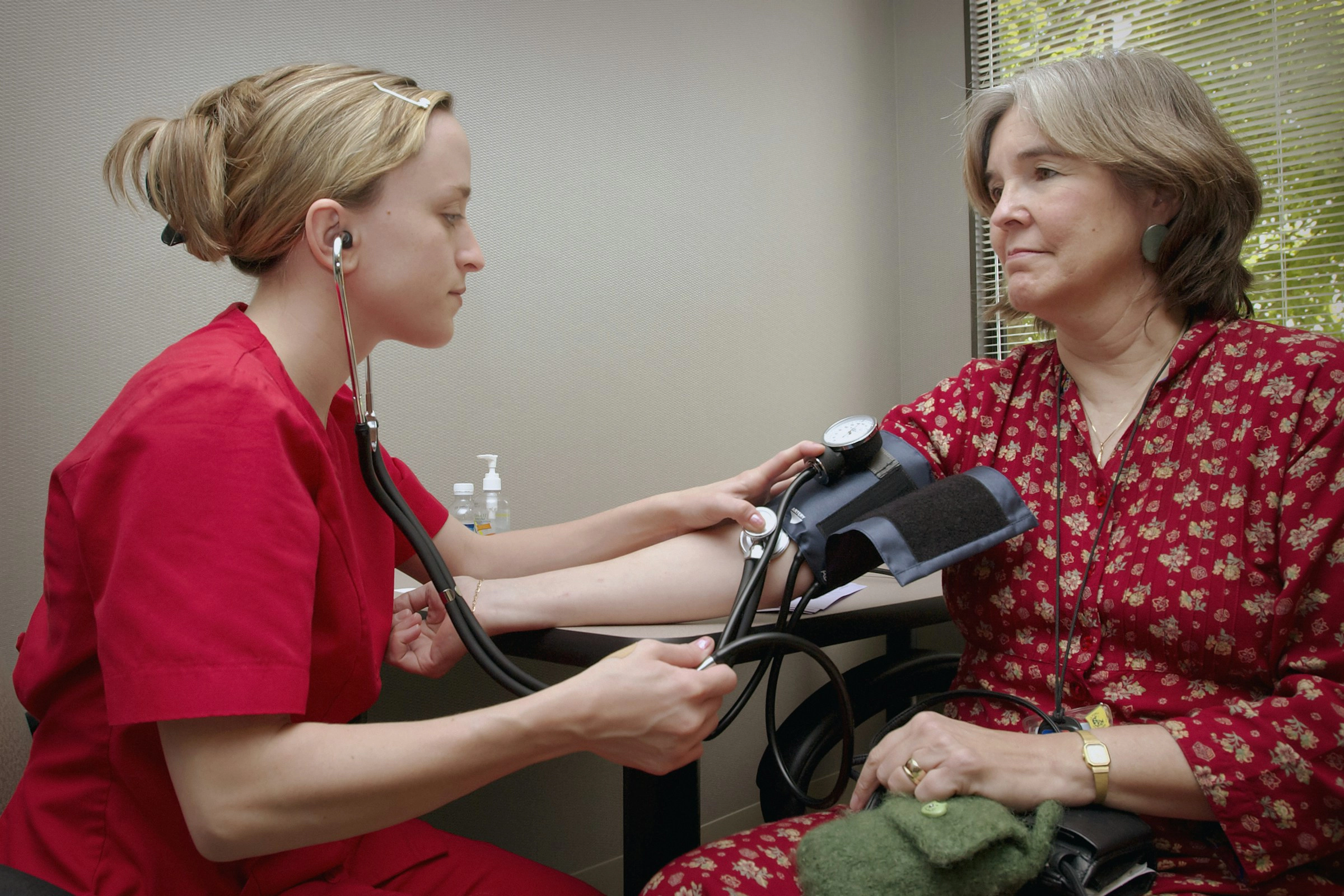
A NAC OSCE study partner plays two of the three people in each station: your patient and your examiner. The Medical Council of Canada (MCC) calls them the standardized participant (SP) and the physician examiner (PE), and its free sample cases give each one a page. Partners come from bridging programs, physician associations and candidates booked into your session.
Ten scored stations and one pass score
The National Assessment Collaboration (NAC) Examination is a half-day objective structured clinical examination for international medical graduates (IMGs) applying to Canadian residency (MCC). It's held twice a year, generally in May and September. You rotate through 12 stations of 11 minutes. Two are pilot stations that don't count, so 10 are scored. With unscored waiting stations, the exam runs about three and a half hours, and MCC says to plan for five on site. Outside each door you get 2 minutes to read the instructions (exam day). They give the patient's name and age, the station type and the setting, such as a family practice clinic or an emergency department. The 11 minutes start at the signal, however late you walk in.
Inside, one PE rates up to seven competencies: history taking, physical examination, investigations, data interpretation, diagnosis, management and communication skills. Your total is the average of the 10 station scores, adjusted for that day's station difficulty by a method MCC calls linking (results). It's reported on a scale of 500 to 700, and since May 2023, 577 is a pass. About eight weeks later comes a Statement of Results: pass or fail, your total and the cut score. A Supplemental Information Report adds subscores in three domains (assessment and diagnosis, management, communication skills) and how you compare with other candidates.
Three eligibility rules matter for timing (eligibility). You get three attempts in all, passed or failed. Only your most recent result is valid, and it never expires, so a retake replaces your old result, even a pass. And you can't sit two sessions in a row.
Patient, then examiner: what a NAC OSCE study partner does
MCC's free NAC resources page offers three sample cases "for role-play practice with peers", plus two videos. Each PDF has three parts: the candidate instructions, a script for the SP, and a page headed "Information for the physician examiner only". The candidate gets the first part; the partner learns both of the others:
| Role | Reads beforehand | During the station | At the 8-minute warning signal |
|---|---|---|---|
| Candidate | The instructions only, for 2 minutes | Takes the history, examines and counsels, in the order they choose | Turns to the examiner if the station has oral questions |
| Partner as SP | The patient's timeline, opening statement, behavior and must-ask questions | Answers only what is asked; raises every must-ask question, in any order | Stops interacting with the candidate |
| Partner as PE | Key features, findings to give aloud, oral questions, rating scales | Gives vital signs or findings only when asked, or once an examination is complete | Reads the oral questions as written, or says there are none |
The Jacob Simms case shows the switch. Its instructions give the candidate 8 minutes for a history and a physical examination. At the signal, the examiner opens with "You have 3 minutes to answer the following 3 questions" and reads each one as written. A question is repeated once at most, and a lab results sheet comes before the last. The Sandrine Thomas and Stan Mortensen cases have no oral questions. A candidate who looks up at minute 8 hears: "There are no oral questions. Please continue with the patient."
The SP pages also script reactions. The Thomas patient opens up only if the candidate is empathetic and nonjudgmental; otherwise she answers briefly, with less eye contact. The Mortensen patient resists lifestyle advice a little. Your partner scores your communication on how you handle them.
On a call, the physical examination becomes the narration MCC asks for anyway: each maneuver, what you're looking for, what you find. For findings the examiner page doesn't list, the examiner answers "Normal, please continue" or "Noted, please continue" instead. Genital, rectal, vaginal, breast and reflex examinations are never performed; you tell the examiner you would do one. In a NAC OSCE study group of three, the third person takes only the examiner page.
Scoring each other with MCC's rating labels
MCC's examiners score with short key-feature checklists, oral questions and five-point rating scales (technical report, 2025). Key features are the few steps that decide a case: the Thomas case lists four, from a history of drug use to a safe opioid prescribing plan. The scale runs from Unacceptable through Borderline unacceptable, Borderline acceptable and Acceptable to Above. Every label is judged "as compared to a recent Canadian graduate accepted into postgraduate training" (rating scale criteria). The sample cases use two or three scales per station, from History Taking, Management and Communication Skills.
Peers handle the checklist better than the overall judgment. At the University of Ottawa, 27 fourth-year students and 27 teaching doctors scored the same 66 second-year students in a nine-station practice OSCE (Moineau and colleagues, Medical Education, 2011). Their checklist scores correlated at 0.56 to 0.86 per station, but their global ratings at only 0.23 to 0.78. Faculty rated the students' feedback 4.02 to 4.44 out of 5. A scoping review of 13 studies from Western University found the same lean (Khan, Payne and Chahine, Medical Teacher, 2017). Peer examiners tend to give better global ratings than faculty, and their checklist ratings vary.
So when you play the examiner, tick key features strictly, and when you're torn between two labels, give the lower one. Don't expect a perfect station, either: on the 2025 forms, average station scores ran from 0.47 to 0.55 on MCC's 0-to-1 scale, and 82.6% of candidates still passed.
What the 2025 test forms asked for most
MCC builds every form to the same specifications and reports how the 10 scored stations of each 2025 form met them:
| Competency | MCC's specification | May 2025 | Sept. 2025, form 2 | Sept. 2025, form 3 |
|---|---|---|---|---|
| Communication skills | 6 or more | 10 | 10 | 10 |
| History-taking | 6 to 7 | 7 | 6 | 7 |
| Combined history and physical examination | 2 to 3 | 3 | 3 | 3 |
| Physical examination alone | 1 | 0 | 0 | 0 |
| Management | 3 or more | 8 | 5 | 8 |
| Diagnosis | 3 or more | 5 | 7 | 8 |
| Investigations | 3 or more | 3 | 4 | 3 |
| Data interpretation | 3 or more | 3 | 3 | 3 |
Communication was scored in every station, and since 2020 the examination-only station has been replaced by a combined one. Most rehearsal is therefore talk: histories, explanations and counseling, with an examination in two or three cases of ten. Disciplines are spread too. Medicine and surgery get two to four stations each; psychiatry, obstetrics and gynecology, pediatrics and geriatric medicine one or two each; urgent care one. Up to 20% of management must be therapeutics-specific (test specifications). When a NAC OSCE study partner writes cases for you, ask for that mix.
May or September: how each session went
These are MCC's sessions since 577 became the pass score:
| Session | Passed |
|---|---|
| May 2023 | |
| Sept. 2023 | |
| May 2024 | |
| Sept. 2024 | |
| May 2025 | |
| Sept. 2025 |
Source: MCC, NAC Examination Annual Technical Report 2025, Table 8
In each of the three years, September passed a larger share than May, and repeat takers trailed first-timers in the year's total (78.9% against 83.0% in 2025). September is also the big sitting: 1,768 candidates in 2025, against 645 in May. Linking should cancel out differences between forms; the report doesn't explain the gap.
Bridging programs and associations with mock stations
MCC doesn't pair candidates; some IMG organizations run practice themselves:
- ISANS, Nova Scotia. The Immigrant Services Association of Nova Scotia's IMG Bridging Program runs group study for the MCCQE Part I. For the NAC, its Clinical Skills Review Program offers encounters with trained simulated patients, mock OSCE sessions and feedback from volunteer physicians. It's open to registered ISANS clients at Canadian Language Benchmark 5 or above: permanent residents, citizens born abroad, CUAET visa holders and refugee claimants.
- BPAO, Ontario. The Black Physicians' Association of Ontario has run a mock NAC OSCE (IMG Support). It's also building a registry of IMGs who have matched or are in the match, for peer support.
- SOCASMA. The Society for Canadians Studying Medicine Abroad holds information meetings with current and past students (SOCASMA). In 2025 it started a branch for francophone physicians trained abroad, with more than 150 members.
We make StudyDuo, which adds one more route. Find Partners has no NAC interest; Medicine is the closest, narrowed by country or city, and you can follow and message people before you meet. Post a 1:1 session with your task (say, "NAC case: Simms"), a length between 30 and 120 minutes and a start time within the next seven days. When someone takes the slot, you meet on video, and each of you can talk on the mic or write in the chat. It works only between people with a verified photo, which takes a selfie check. There's no screen sharing, which suits a station: each of you opens your own pages. Your first 14 days come with Premium. Later, the free plan's hour of video a day fits three stations with four minutes of scoring each (our arithmetic: 2 + 11 + 4 minutes).
What MCC treats as a breach
You bring a signed Candidate Confidentiality Agreement on exam day. MCC's exam-day page lists what breaks it. Revealing the simulated patients' presentations and findings, the oral questions or the case material is a breach. So are discussing how patients reacted with peers, swapping content or question themes with colleagues, and sharing with future candidates or online. You can lose your final result, be reported to regulators and be barred from MCC's exams. A friend who sat in September can still play your patient in May, but can't tell you what came up, not even the topics.
Dates and fees for the May 1, 2027 sitting
Applications for the next session opened on November 18, 2026, and close on December 9 at 11:59 p.m. ET (scheduling). The application costs CAD 3,320, and a seat in Dublin adds CAD 1,500 (MCC fees). You rank up to three centers among Edmonton, Winnipeg, Hamilton, London, Ottawa, Toronto, Windsor, Saskatoon and Dublin, and assignments come out at the end of March. Results follow in late June 2027.
The rule against back-to-back sessions decides who should practice with you. Results for September 2026 came out on November 13 (MCC news). Anyone who sat then can't sit in May, so their earliest retake is September 2027 (our reading of MCC's example: May 2024, then May 2025). For May, a NAC OSCE study partner booked for May 1 too runs on your calendar to the day.
For the UK route, the PLAB 2 guide covers its 16 stations; to fit cases around a job, see studying while working full time.
Doctors weighing the UK instead start with a written paper: a PLAB 1 study group can be joined through groups that sort members by venue and sitting, or started with colleagues booked on your date.
FAQ
Can I take the NAC in French?
Yes. MCC offers it in English or French, but for the May 2027 session only the Ottawa center offers French. MCC researchers studied 2,433 candidates who sat the NAC in 2020 and 2021 (BMC Medical Education, 2024). Scores didn't differ by the exam's language.
Do I need to pass the MCCQE before the NAC?
No. CaRMS asks IMGs for both results to enter the R-1 match, and MCC lets you sit the two exams in whichever order you choose.
Does passing the NAC get me a residency?
No, it's one requirement among several. In the first iteration of the 2026 R-1 match, CaRMS's data snapshot shows 80.6% of IMGs who graduated that year matching, against 47.8% of IMGs who graduated in earlier years.
What if my examiner on the day is unusually harsh?
Each scored station has its own PE, and MCC checks every examiner after the session. A PE whose average sits more than three standard deviations from the others is flagged as a hawk or a dove. MCC then checks the cohort they scored, and in 2025 two PEs stayed flagged at every step.
Can I write notes during a station?
Yes, in the one small notebook MCC gives you, and also while you wait at the door. Notes aren't scored, you can't add pages, and the notebook goes back intact when you sign out.