StudyDuo
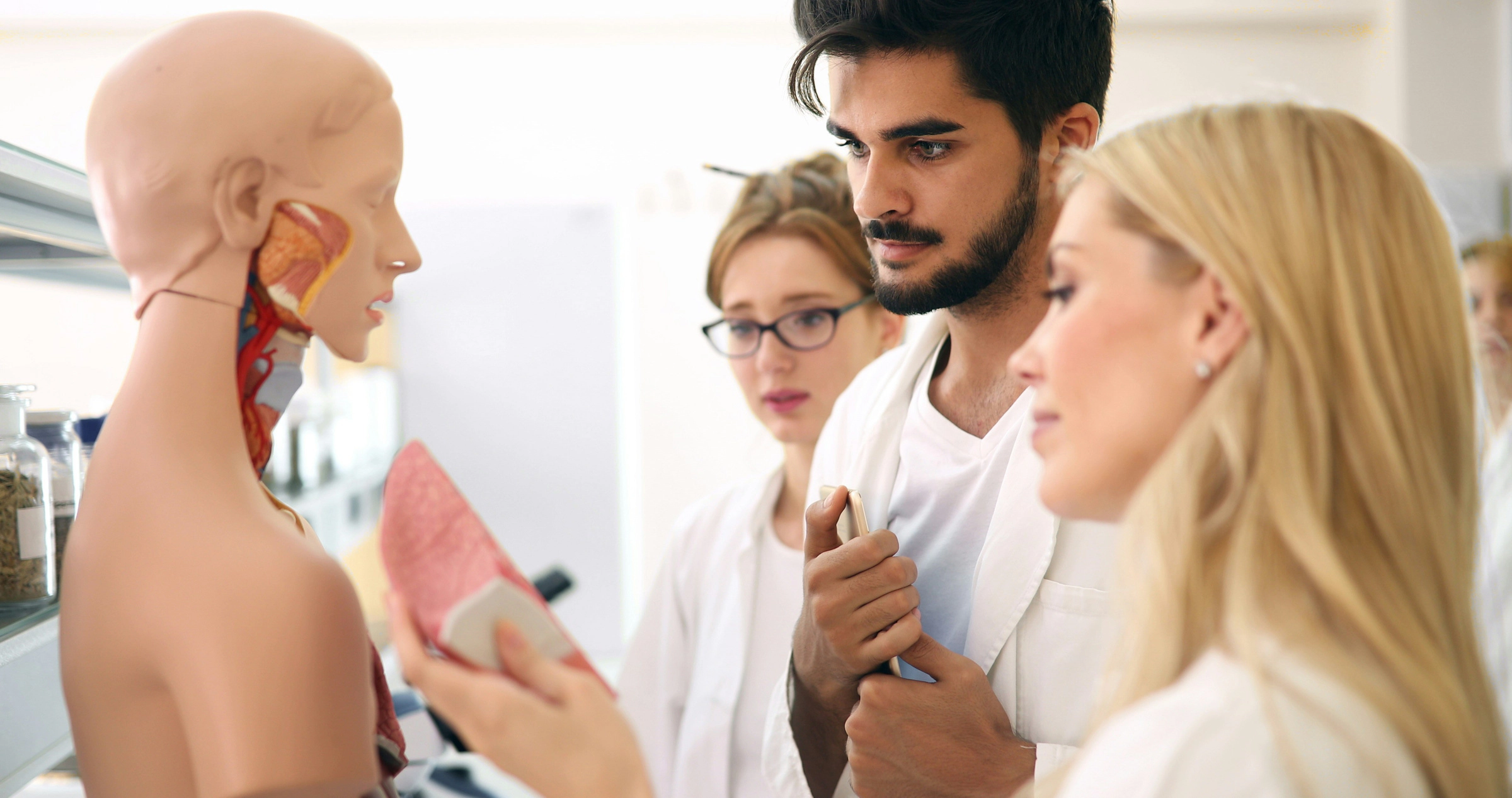
A medical school study group earns its time on tasks that need other people. That means explaining anatomy and physiology aloud, going through the questions each of you missed, and practicing clinical skills on each other. Keep Anki, the first pass through lectures and timed question blocks for time alone. In years 1 and 2, plan one or two meetings a week around your block exams.
How preclinical students study now
Lectures are no longer where a medical class reliably meets. In the AAMC's 2025 Year Two Questionnaire, 9,883 second-year students at 157 US medical schools said how often they attend class (AAMC, Y2Q 2025). Only 37.6% went to in-person pre-clerkship lectures most of the time, up from 31.5% in 2023, and 19.1% almost never did. Virtual lectures, on video or as podcasts, were watched a little more often:
| How often | In person | Virtual |
|---|---|---|
| Almost never | ||
| Occasionally | ||
| Somewhat often | ||
| Often | ||
| Most of the time |
Source: AAMC Year Two Questionnaire 2025 (about 9,800 answers per item)
Many students go through lectures on their own schedule, which leaves fewer fixed times with classmates. In the same survey, 12.1% agreed that they often feel isolated at school. A study group puts back a set time to work through the material with people from your class.
What to do in a medical school study group, task by task
| Task | Alone or together | How |
|---|---|---|
| First pass through lectures | Alone | At your own speed; note what you didn't follow, for the group |
| Anki and spaced review | Alone | Cards come due on your own schedule; the group can agree on one shared deck |
| Question blocks | Alone and timed, then together | Each person brings their misses; the group explains the concept behind each one |
| Anatomy | Together | Quiz each other on models, atlas plates or lab specimens; trace nerves and vessels aloud |
| Physiology and biochemistry pathways | Together | Draw them from memory in turns, with the others checking against the book |
| Practice exams | Alone, then a short review together | Compare weak topics, not copied questions |
| History taking and physical exams | Together | Practice on each other with the school's checklist |
| Ethics and communication cases | Together | Argue the case, then check it against the course's framework |
The split follows one rule: work that depends on your own memory and pace stays solo, and work that improves when someone checks it goes to the group. For more formats, see these 20 study group activities and what each trains.
Running the group tasks
Missed questions
Each person brings their two most instructive misses from the week's blocks. The person who missed a question explains their reasoning first; then someone who got it right explains theirs. The group names the one fact or concept that separates the two lines of reasoning, and that concept becomes a new card in the shared deck.
Anatomy
Run it as a fast drill. One person points to a structure on a model or an atlas plate. The next person names it, gives its blood and nerve supply, and says what goes wrong clinically when it's damaged, then points to the next structure. In the weeks before a practical, use the lab's own specimens if your school allows study time there.
Pathways and mechanisms
One person draws a pathway from memory on a whiteboard or a shared screen, with no notes, while the others follow the textbook figure. They stop the drawer at the first error and ask a question that leads to the fix, instead of giving it. Then the pen passes on. Clotting, the renin-angiotensin system and the cardiac cycle all work well this way, because each step depends on the last.
History taking and physical exams
Work in threes: one plays the student, one the patient, one observes with the school's checklist. The observer names one thing done well and one to fix, and the roles rotate after each case.
What peer teaching does and doesn't do
Can classmates teach each other as well as faculty? In a 2016 meta-analysis of ten studies, Eliot Rees and colleagues at Keele University compared students taught by peers with those taught by faculty or clinicians (Medical Teacher). They found no significant difference in knowledge (standardized mean difference 0.07) or in skills (0.11). They added that teaching builds the tutor's own knowledge and teaching skills.
No difference is a modest result, but a useful one: a classmate who has prepared a topic can stand in for a review lecture. For the board years, our USMLE study partner guide covers a larger meta-analysis that split the effect by clinical and preclinical students.
Anki stays solo
Spaced-repetition flashcards are what groups argue about most, and two small coursework studies came out mixed. In a pilot at one medical school, 45 first-year students were sorted by how much they used Anki during an eight-week anatomy and physiology course (Levy and colleagues, 2023). Exam averages across the four groups ran from 85.9% to 91.7%, with no significant difference.
In a 2025 study of 53 first-year graduate-entry medical students, 80% used Anki (Haughey and colleagues). Overall, it brought no significant benefit. Students who used it extensively did better than those who didn't keep it up, and Anki use went with higher physiology exam scores.
Consistency is the part a group can help with. Agree on one shared deck, and say at the start of each session whether you're caught up on reviews. The reviews themselves still happen alone.
A week around a block exam
Here's one way to fit a medical school study group into a block:
- Every day, alone: Anki reviews and the day's new lectures.
- Two evenings, alone: a timed question block on the week's topics, with a log of every miss.
- One 90-minute group session: 30 minutes on misses, 40 on a pathway or a region at the whiteboard, 20 on a clinical skill or a case.
- The week of the exam: everyone takes a practice exam alone, then the group spends an hour on the weakest topics.
Keep the group session on the same day each week, so nobody has to renegotiate it after every exam.
Signs the group is costing you time
- You leave without a list. Every session should end with the topics each person will fix before the next one.
- Sessions go through slides. Re-reading lectures together is the most passive way to spend a group hour.
- The same person explains every week. Rotate who leads, so everyone does the explaining.
- Question blocks get skipped to prepare for the meeting. The group exists to support the solo work, not to replace it.
Honor codes and shared material
Read your school's honor code before you share anything that came from an exam. Wright State's Boonshoft School of Medicine, for example, lists "reproducing or sharing exam questions in any form (orally or writing/images)" as an honor code violation (Examination Policy 413). The rule covers its own exams and NBME exams alike.
Board exams have a national rule. USMLE treats reconstructing questions from memory, sharing them online, or discussing test questions with other examinees as irregular behavior, before or after the exam (USMLE). A finding becomes part of your permanent USMLE history. Your own notes, diagrams and explanations are the safe things to share. Ask your course director about anything else.
Finding a med school study buddy online
Your own class shares your exam calendar, so it's the first place to look for a med school study group. When schedules don't line up, one partner from anywhere can still keep you company for the solo hours.
A medical school study group can also meet partly online. StudyDuo's Find Partners can be searched by interests such as USMLE, and by country and city, and you can follow people or message them. For the solo hours, Focus Room keeps you company: aim the camera at your notes if you'd rather not show your face. For a review call between two people, schedule a 1:1 session, which has sound. Each of you will need a verified photo, and the minimum age is 16. More setups are on the online study group page, and for the year before medical school, see the MCAT study partner guide.
FAQ
How many people should be in the group?
Few enough that everyone explains something in every session. A larger group can split into pairs for the explaining part and come back together for the questions.
Should everyone use the same resources?
For the shared parts, yes: the same lecture slides and the same deck make it easy to quiz each other. Question banks can differ, since you bring misses as topics, not as questions.
Classmates or students from other schools?
In years 1 and 2, classmates, because you share the lectures and the exam calendar. For board preparation, a partner from another school works just as well, since everyone sits the same exam.
What if the group slows me down?
Keep the first pass and your reviews solo, and use the group only for explaining and missed questions. If sessions keep running long, cut them to one topic each.