StudyDuo
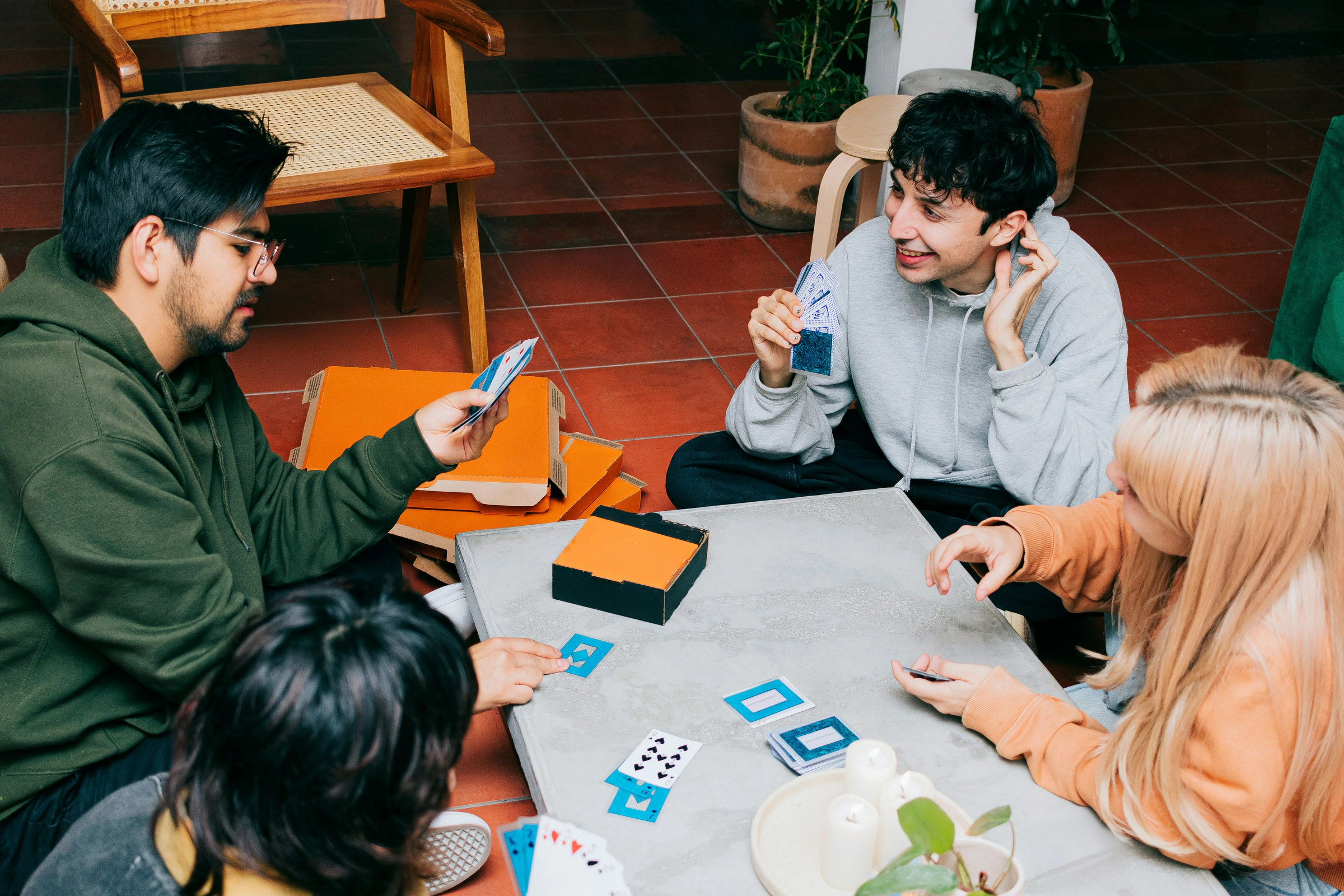
The best study group ideas make every member produce something: an answer before the discussion, an explanation in their own words, an exam question, a map. Pick activities by what your next exam asks for, and keep first reading and memorizing for time alone. Below are 20, with what each trains, how long it takes and whether it works on video.
Why some group activities beat others
Michelene Chi and Ruth Wylie's ICAP framework sorts what learners visibly do into four modes: passive, active, constructive and interactive (Educational Psychologist, 2014). Roughly, listening is passive and highlighting or copying is active. Producing your own explanation or map is constructive, and building on each other's ideas in conversation is interactive.
The framework predicts that learning grows in that order. Muhsin Menekse, Glenda Stump, Stephen Krause and Chi tested it in engineering classes (Journal of Engineering Education, 2013). In their second study, students' gains rose from passive to active to constructive to interactive, and every step up was significant. In the first, interactive activities also produced deeper learning on the hardest inference questions.
For a group, the lesson is blunt: while one person explains, everyone else is passive. One change turns that around. Instead of one member summarizing the lecture, everyone writes a three-line summary alone, then the group compares them and merges the best lines. The ideas below are built the same way, so that everyone answers, writes or argues.
20 study group ideas at a glance
"Indirect" means research supports a related method used alone, not this group version.
| Idea | What it trains | Evidence | Minutes | On video |
|---|---|---|---|---|
| 1. Vote, discuss, revote | Concepts and common misconceptions | Peer instruction (below) | 10 | Yes, with a poll |
| 2. Two-stage practice exam | Recall under exam conditions | A controlled class study (below) | 60 | Yes, with a shared doc |
| 3. Write and swap exam questions | Understanding, guessing what's asked | Question generation (below) | 20 | Yes |
| 4. One shared concept map | Links between ideas | A meta-analysis (below) | 25 | Yes, on a shared whiteboard |
| 5. Recall rounds, no choices given | Terms, formulas, definitions | The testing effect (below) | 15 | Yes |
| 6. Split the topic, teach your part | Explaining a topic you own | Indirect: learning by teaching | 30 | Yes |
| 7. Muddiest point round | Finding the gap you share | No direct test | 10 | Yes |
| 8. Mistake hunt in each other's work | Spotting errors | No direct test | 15 | Yes, sharing screens |
| 9. Narrated worked solution | Step-by-step reasoning | Indirect | 15 | Yes |
| 10. Past-paper post-mortem | Sorting lost marks by cause | No direct test | 20 | Yes |
| 11. A one-page fact sheet | Deciding what matters | No direct test | 20 | Yes, with a shared doc |
| 12. Timed sprint, then compare methods | Speed and other ways to solve | No direct test | 25 | Yes |
| 13. Argue the side you disagree with | Essay arguments and evidence | No direct test | 20 | Yes |
| 14. Case discussion | Applying rules to new cases | No direct test | 30 | Yes |
| 15. Mock oral exam | Answering aloud under pressure | No direct test | 15 each | Yes |
| 16. Essay outline swap, marked to the rubric | Structure of written answers | Indirect | 25 | Yes |
| 17. A diagram explained label by label | Processes and structures | No direct test | 15 | Yes, camera on the page |
| 18. Rank topics by exam weight and confidence | Choosing what to review | No direct test | 10 | Yes |
| 19. Silent work block | Solo work with people around | Little research on body doubling | 50 | Yes, mics off |
| 20. Exit round | One thing learned, one to review | No direct test | 5 | Yes |
The five ideas with the most evidence
Five of the ideas have been tested directly, in class experiments or meta-analyses. Here's how to run each one.
1. Vote, discuss, revote
Someone puts a multiple-choice concept question to the group. Everyone votes alone first, then argues it out in pairs, then votes again. Only then does anyone reveal the answer. Pick questions people are likely to split on; a question everyone gets right teaches nothing.
This is peer instruction. Catherine Crouch and Eric Mazur reported on ten years of teaching introductory physics for nonmajors this way (American Journal of Physics, 2001). Students improved in both conceptual reasoning and quantitative problem solving.
2. A practice exam, taken twice
Everyone takes a timed practice exam alone. Straight after, the group retakes it together and must agree on one answer per question, with no notes. Then you check the key. Of all the study group ideas here, it's the closest to the real exam.
Brett Gilley and Bridgette Clarkston tested this two-stage format in a natural disasters course at the University of British Columbia (Journal of College Science Teaching, 2014). Each student retook some questions in a group and others alone. Three days later came a surprise quiz on all of them:
| Attempt | Retaken in a group | Retaken alone |
|---|---|---|
| First try, alone | ||
| The retake | ||
| Surprise quiz 3 days later |
Weaker, middle and stronger students gained alike. The limit is time: in a large biology course, group exams raised scores on the day but not retention on cumulative questions in later exams (Leight and colleagues, 2012). So bring the same questions back a week or two later.
3. Write the exam questions yourselves
Each person writes five questions the way your exam would ask them, with answers. The group swaps and answers them, and questions nobody can answer become next session's topic.
In a 1996 review, Barak Rosenshine, Carla Meister and Saul Chapman looked at studies that taught students to generate questions about what they read (Review of Educational Research). The median effect size was 0.36 on standardized tests and 0.86 on the researchers' own comprehension tests.
4. One shared concept map
Put the chapter's key terms on a shared whiteboard. Members take turns linking two terms with a labeled arrow ("causes", "is a type of"), and anyone can challenge a link.
John Nesbit and Olusola Adesope pooled 55 studies with 5,818 learners, from grade 4 to university (Review of Educational Research, 2006). Using concept maps went with better retention across settings. Effects ranged from small to large, depending on how the maps were used and what they were compared with.
5. Recall rounds with no options
One person reads a prompt; everyone writes the answer from memory, then shows it. Leave out the multiple choice. In Christopher Rowland's 2014 meta-analysis of testing versus restudying, practice that made people recall answers helped later memory more than practice where they only recognized them (Psychological Bulletin).
Group study ideas for exams
Line the activities up with the calendar:
- Three weeks out: write and swap questions, build concept maps, rank the topics.
- Two weeks out: a two-stage practice exam, then a post-mortem of the marks you lost.
- The last week: recall rounds, and vote, discuss, revote on the questions people still split on. Add mock orals if the exam is oral.
- The day before: a short exit round. Nothing new.
What to do in a study group on video
Nearly everything in the table works on a call. Use a poll for votes, a shared doc for the group stage of a practice exam, a whiteboard for maps and breakout rooms for pairs. For diagrams, point a camera at the page.
The silent parts need people around more than a call. In StudyDuo's Focus Room, which never closes, microphones stay off and each person's current task shows under their video. If your group wants one fixed time, Study Hour starts once a day, shows the time in each member's own time zone and runs for an hour without a break. More ways to meet are on the online study group page.
Study group activities that waste time
- Reading notes aloud. It's passive for everyone listening.
- One member lecturing the rest. The lecturer works; the others are passive, unless they answer questions afterward.
- Copying the best set of notes. Active at most, and nothing anyone produced themselves.
- Recalling a list together before anyone tries alone. Groups recalling together remember less than the same people working separately; the research is in Study Alone or in a Group?
- Talk with no question on the table. These rules for studying with friends keep sessions from drifting.
Whichever study group ideas you pick, end each session by choosing the next session's two activities and who prepares them. With one partner instead of a group, see the habits of a good study partner.
For sessions built around one subject, see an organic chemistry study group and a physics study group.
FAQ
How many people should a study group have?
Few enough that everyone speaks in every round. For activities done in pairs, an even number means nobody sits out.
How long should a session last?
Long enough for two or three activities from the table, with a short break between them. Stop while people are still answering, not when they've stopped.
Does a study group need a leader?
Rotate one. A facilitator who picks the activities and keeps time for a single session stops any one member from taking over.
What if members are at very different levels?
Choose activities where everyone answers before anyone explains, such as votes, recall rounds and practice exams. They show each person's level without turning the session into a lecture.