StudyDuo
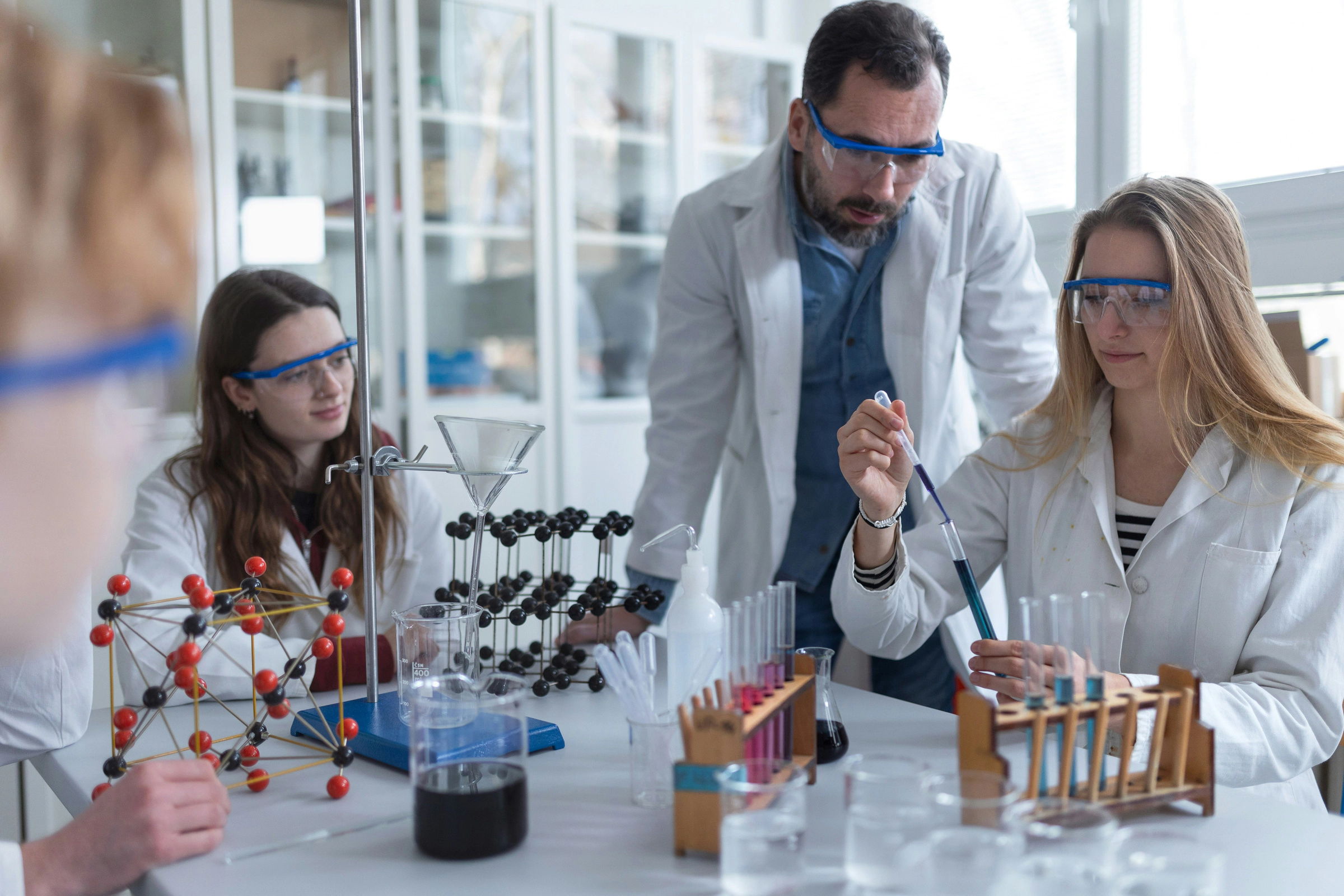
An organic chemistry study group pays off when every member pushes the arrows, not only the fastest one. Build each meeting from four kinds of work: curved-arrow drills, a mechanism drawn at the board in turns, molecular models for stereochemistry, and a synthesis puzzle solved out loud. Memorizing reagents stays solo, on your own flashcards.
What peer-led workshops changed in organic chemistry
Much of the evidence for studying organic chemistry in groups comes from peer-led team learning, or PLTL: small groups that meet weekly to work problems with a student leader. At Portland State University, Carl Wamser compared five years of organic chemistry students who chose a two-hour weekly workshop with those who didn't (Journal of Chemical Education, 2006). About 30% chose the workshop:
| Outcome | Took the workshop | Didn't |
|---|---|---|
| Earned a C- or better | ||
| Passed all three terms in one year | ||
| Share of course points |
Workshop students also scored at the 77th percentile on the ACS exam, against the 69th. They chose the workshop themselves and had a slightly higher overall GPA (3.26 against 3.14), but Wamser found the gains larger than that difference explains.
The University of Rochester ran the same model for its whole organic class from 1996 to 1999. Against the traditional recitations of 1992 to 1994, Lydia Tien, Vicki Roth and Jack Kampmeier reported significantly better performance, retention and attitudes (Journal of Research in Science Teaching, 2002). A student group without a trained leader isn't the same thing, but it can copy the format: problems, not lectures, with everyone working.
Setting up an organic chemistry study group
- Same course, same instructor. Exams in organic chemistry follow the instructor's choice of reactions and notation, so members from one lecture section can share problems directly.
- Four or five people. That's enough for one person at the board, one checking, and the rest working the same step on paper.
- One model kit on the table, or one per person if you meet online and each holds theirs to the camera.
- A board everyone can see. A whiteboard in a library room, or a shared drawing screen on a call.
On a call, one member draws where all can see it and the rest copy each step onto paper. On StudyDuo, Find Partners has Chemistry among its interests, filtered by country and city, which helps when your own section is small. With just one partner, book a 1:1 on StudyDuo instead: you can speak there, and the camera can point at your paper while you talk through a mechanism.
One meeting in five blocks
A weekly meeting of about 90 minutes fits five blocks, each a different skill the exam asks for:
| Block | Minutes | What it trains |
|---|---|---|
| Curved-arrow drills | 10 | Reading and writing electron flow |
| Mechanism in turns | 25 | Predicting with mechanisms, not decorating answers |
| Models in hand | 15 | Translating between stereochemical drawings |
| Synthesis out loud | 25 | Combining strategies on a multi-step problem |
| Mixed-reaction round | 10 | Recognizing reaction types out of order |
Block 1: curved-arrow drills
Start with ten minutes of arrows, because everything after depends on them. Alison Flynn and Ryan Featherstone analyzed University of Ottawa students' exam answers on two kinds of questions about unfamiliar reactions (Chemistry Education Research and Practice, 2017):
- Given the reactants and products, draw the arrows.
- Given the reactants and arrows, draw the products.
Students scored significantly higher on the first kind. Few drew reversed or illogical arrows, but the authors describe a new kind of error: "picking up electrons and setting them down on a different atom". Scores were also lower for compounds with implicit atoms, for intramolecular reactions and for some ways the reactants were drawn on the page.
So in the drill, each member writes one step of each kind for the person on their left, from a reaction they haven't covered. Spend more of the time on the second kind, the harder one. Before anyone answers, they redraw the structure with every implicit hydrogen and lone pair shown, the strategy the authors found students rarely used.
Block 2: a mechanism at the board, in turns
Cover the product before anyone starts. One study followed second-year students through a year of organic chemistry (Grove, Cooper and Rush, 2012). When predicting products, many chose not to use mechanisms at all, even when asked to. The same team found that students who did use them solved more problems that needed knowledge transferred to something new, though not routine ones (Grove, Cooper and Cox, 2012).
- One member draws the first step: where the electrons start, where they go, the formal charges after.
- The next member draws the second step. Anyone can stop the drawer at a step and ask "where did that pair come from?"
- When the mechanism ends, uncover the product and compare. A mismatch means one step was wrong; find it before moving on.
- Change one condition, such as a bulkier base or a polar aprotic solvent, and redraw only the steps that change.
Block 3: models in hand for stereochemistry
Chair flips, Newman projections and wedge-dash drawings are translation problems: the same molecule in a different picture. Andrew Stull, Mary Hegarty, Bonnie Dixon and Mike Stieff tested that translation in three studies, with and without concrete models (Cognition and Instruction, 2012). The groups with models outperformed the controls. Students who received models and actually used them did better than those who left them on the table. Model use predicted accuracy better than spatial ability did.
That last result is the instruction for an organic chemistry study group: hold the model and turn it. One member builds the molecule from a wedge-dash drawing. Another rotates it to sight down a bond while a third draws the Newman projection, and the drawing is checked against the model, not against memory.
Block 4: a synthesis puzzle out loud
Synthesis problems pull together most of the course, and without a systematic method even the strongest students struggle, the authors of this study write. Nicholas Bodé and Alison Flynn analyzed more than 700 answers to synthesis problems from final exams (Journal of Chemical Education, 2016). Successful answers showed six strategies, and most used several together. The six make a checklist for the member who solves aloud while the others tick:
| Strategy | Question the checker asks |
|---|---|
| New bonds | Which bonds in the target weren't in the starting material? |
| Added atoms | Which atoms came from reagents? |
| Regiochemistry | Which positions have to end up next to each other? |
| Atom mapping | Which atom of the start becomes which atom of the target? |
| Retrosynthesis | What could the last step have been, and the one before? |
| Mechanisms | Does each proposed step work with arrows drawn? |
These strategies were often missing from unsuccessful answers, the authors note. Students may not have known them, believed in them, or written them down. Writing each one down on the board is the point of doing the puzzle in a group.
Block 5: a mixed-reaction round
End with ten reactions drawn from different chapters, shuffled, and each member names the reaction type or the product before anyone checks. Luke Eglington and Sean Kang taught undergraduates to sort diagrams of organic compounds into chemical categories (Journal of Applied Research in Memory and Cognition, 2017). Two days later, students who had seen the categories interleaved classified new compounds better than those who had studied them one category at a time. The advantage held in four experiments, including when the distinguishing features were highlighted.
A shuffled round also mirrors the exam, where nothing tells you which chapter a question came from.
Between meetings
Everything else happens alone: reagent flashcards, the assigned problem sets and reading ahead. Bring the problems you couldn't finish to the next meeting as the drill material. An organic chemistry study group that meets weekly through the term should keep one fixed solo hour as well. StudyDuo's Study Hour gives you one: the same hour every day, shown in your time zone, an hour of focus with no break.
If you're taking organic chemistry on the way to medical school, organic chemistry comes back on the MCAT; planning with an MCAT study partner covers that test. For activities that work in any subject, see these 20 study group ideas, and for ways to meet online as a group, the online study group page.
FAQ
Should we split the chapters between us?
Not for organic chemistry. Each reaction builds on the electron-flow rules from earlier chapters, so every member needs to practice every step, and the rotation above gives everyone a turn at the board.
Do we need a physical model kit?
A kit is what the model studies tested, and holding it is what helped. If one isn't in your budget, ask whether your chemistry department or library lends them.
What should we change the week before an exam?
Draw the board mechanisms from the reactions your instructor lists for the exam, and double the mixed round to 20 reactions shuffled across every chapter it covers.